
On this page
- What Is a UAE Will and Do You Need One?
- What Happens If You Die Without a Will in the UAE?
- Who Can Make a Will in the UAE?
- Can Muslims and Non-Muslims Make a Will in the UAE?
- Where Can You Register a Will in the UAE?
- What Types of Wills Are Available in the UAE?
- How Much Does a Will Cost in the UAE?
- What Can a UAE Will Cover?
- How Does Guardianship Work in a UAE Will?
- How Do You Make a Will in the UAE?
- What Documents Do You Need for a UAE Will?
- What Happens After a UAE Will Is Registered?
- What Happens to Your Bank Accounts?
- Start Your UAE Will Online
Quick answer
- A UAE Will sets out how your UAE estate is distributed, names an executor, and appoints a guardian.
- Four authorities accept expat Wills. ADJD and DIFC register them, and ADGM and Dubai Courts notarise them. Eligibility and cost differ by religion, nationality, age and asset location.
- Register your Will with a UAE authority. Courts and banks look for a registered or notarised Will, and an unregistered one may not be enforced as you intend.
UAE Will fees and ages
- AED 950ADJD regular registration fee, per Will
- AED 5,000+DIFC registration, set by Will type
- 21+ / 18+Minimum age: ADJD and ADGM 21, DIFC 18
General information, not legal advice. Rules and fees differ by religion, nationality, residency and asset location. Confirm with the registering authority before acting.
What Is a UAE Will and Do You Need One?
In short
A UAE Will is a Will registered or notarised by a UAE authority, such as ADJD or DIFC. It names who inherits your UAE assets, who administers your estate and who cares for your minor children. It is optional, but without one default succession rules decide.
What Is a UAE Will?
- UAE WillDefinition
- A legal document registered or notarised by a UAE authority that records how your UAE assets pass on death, who administers your estate, and who cares for your minor children.
Is a Will Mandatory in the UAE?
A Will is not mandatory in the UAE. Without one, default succession rules decide who inherits, and a court decides guardianship of your minor children. It matters more for expats, whose assets, family and home country rarely sit in one legal system.
Is a Will Valid Without Registration?
Not reliably. UAE courts and banks look for a Will registered or notarised by a UAE authority, and may not act on an unregistered one.
Registered UAE Will vs the alternatives
- RecommendedRegistered UAE Will
- Courts and banks look for it
- Names your executor and guardian
- Sets your shares, within the law that applies
- SlowerWill from another country
- Needs a legalised Arabic translation
- Steps vary by court and country
- Probate is slower and costlier
- Not bindingLetter of wishes
- Not a Will and not binding
- Default succession rules still apply
A registered Will can:
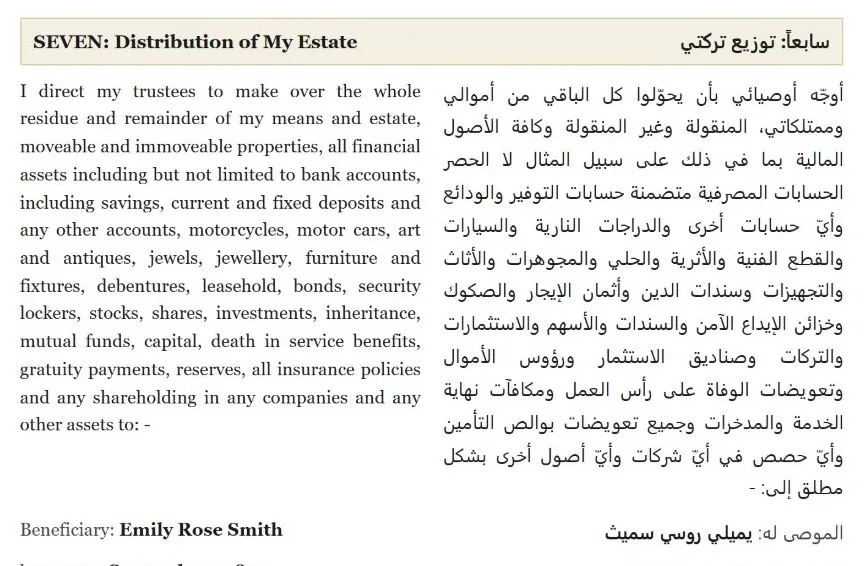
- Direct your UAE assets to the beneficiaries you name, in the shares you set, subject to the law that applies.
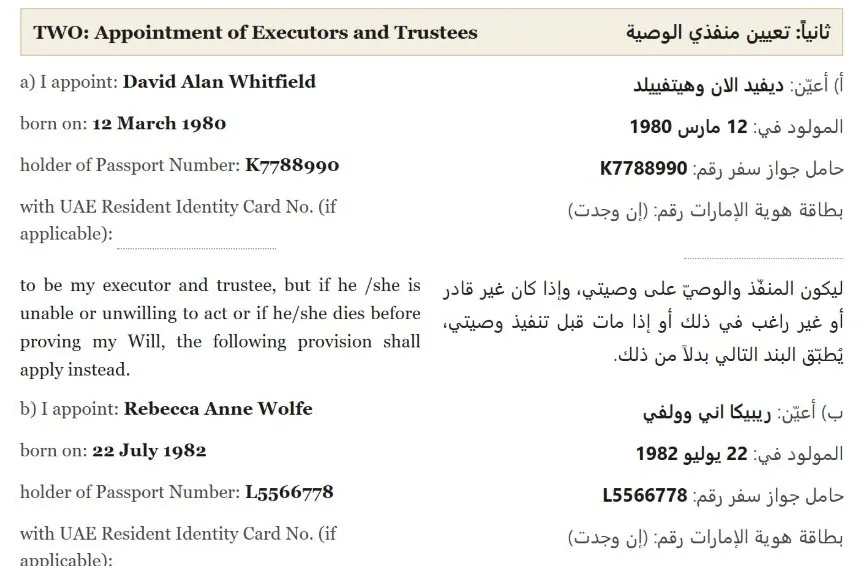
- Name the executor who applies for authority to administer your estate, instead of leaving the court to appoint one.
- Put your guardian nomination before the court, subject to confirmation.
- Record your choice of legal framework, where the authority allows one, in place of default succession rules.
Does a Will From Another Country Cover Your UAE Assets?
Not automatically. A UAE court usually requires a legalised Arabic translation, the steps vary by court and country, and probate on a foreign Will is slower and costlier. Register a UAE Will for your UAE assets and keep a home-country Will for property abroad, or use a DIFC Will that covers worldwide assets.
What Happens If You Die Without a Will in the UAE?
In short
Without a registered Will, default succession rules decide who inherits your UAE assets, and a court decides guardianship of your minor children. Under the non-Muslim civil rules, a surviving spouse takes half and the children share the other half equally.
- Accounts restrictedBanks may block accounts once notified of the death.
- Assets frozenProperty, vehicles and shares stay in your name until a court order.
- Default sharesSuccession rules decide who inherits, not your wishes.
- Court picks guardianThe court decides who cares for your minor children.
What Happens to Your Assets?
Your family usually needs a succession certificate, the court document that authorises transfers where no Will exists. Getting one can take months, and the assets stay where they are until it is issued. With no heirs at all, the new Civil Transactions Law (Federal Decree-Law No. 25 of 2025) directs a foreigner's UAE financial assets to a charitable endowment.
What Does a Surviving Husband or Wife Inherit?
A surviving spouse receives half the estate under the civil rules. The children share the other half equally, with no distinction between sons and daughters. Without children, that second half passes to surviving parents, or otherwise to siblings. Article 11(2) of Federal Decree-Law No. 41 of 2022 sets this formula for non-Muslims in the emirates applying it. Muslim estates follow fixed Sharia shares under Federal Decree-Law No. 41 of 2024 instead, and under either system your family cannot redirect shares after death.
Who inherits without a Will in the UAE (non-Muslim civil rules)
Choose a family situation to see who inherits without a Will.
What Changed in UAE Inheritance Law?
Three federal laws now govern an expat's estate. Guidance that predates them may be out of date.
- 1 Feb 2023Federal Decree-Law No. 41 of 2022Civil inheritance rules for non-Muslims, including the spouse and children formula above.
- 15 Apr 2025Federal Decree-Law No. 41 of 2024Replaced the 2005 personal status law that governs Muslim estates.
- 1 Jun 2026Federal Decree-Law No. 25 of 2025New Civil Transactions Law: heirless foreigners' UAE financial assets go to a charitable endowment, and the age of majority falls from 21 to 18.
Who Can Make a Will in the UAE?
In short
Non-UAE citizens aged 21 or over can register a Will with ADJD, whatever their religion. DIFC accepts people aged 18 or over who have never been Muslim and who own UAE assets or have minor children living with them in the UAE.
Which UAE Will routes are open to you?
Based on each authority's published criteria. Confirm your eligibility with the authority before you apply. Online Wills Advisor prepares ADJD and DIFC Wills for non-UAE nationals.
What Are the Requirements for a Valid Will in the UAE?
A UAE Will needs five things to be accepted:
- CapacityA testator (the person making the Will) of sound mind, acting free of coercion.
- EligibilityReligion, age and a UAE connection that meet the chosen authority's rules.
- IdentificationPassport, plus Emirates ID if you are resident.
- FormalitiesADJD takes a bilingual Arabic and English Will, notarised by video. DIFC needs two witnesses at the signing.
- RegistrationRegistration or notarisation by that authority.
Can Non-Residents Make a Will in the UAE?
Yes. UAE residence is not required by ADJD or DIFC. What matters is a qualifying UAE connection: a title deed, a UAE bank account, or minor children living here.
- DIFCRegister from abroadVirtual signing from any country, through UAE assets or minor children living with you in the UAE.
- ADJDBe in the UAEADJD's guidance asks non-residents to be in the UAE on a visit visa for the video appointment.
- ADGMVisa or entry stampNon-residents need a valid UAE visit visa or entry stamp.
Can Muslims and Non-Muslims Make a Will in the UAE?
In short
Yes. Non-Muslim expats can use ADJD or DIFC. Muslim expats can register an ADJD civil Will or notarise a Sharia-compliant Will, but DIFC registers only people who have never been Muslim.
Can Muslim Expats Register a UAE Will?
- Route 1ADJD civil WillOpen to non-UAE citizens regardless of religion.
- Route 2Sharia-compliant WillNotarised before a UAE local court's Notary Public, and it can include guardianship provisions.
Under Federal Decree-Law No. 41 of 2024, a Muslim testator can generally leave up to one third of the estate by wasiyyah to non-fixed heirs or charity; the remaining two thirds follow fixed Sharia shares. The law also allows Wills between people of different religions. Take advice on how these rules apply to your family.
Muslim Wills in the UAE: the one-third rule
Can UAE Citizens Register a Will Through ADJD or DIFC?
Not through ADJD, whose civil Wills service is for non-UAE citizens. DIFC publishes no nationality rule, but accepts only testators who have never been Muslim. Online Wills Advisor serves non-UAE nationals only.
| Who you are | ADJD | DIFC |
|---|---|---|
| Non-Muslim expat | Open | Open |
| Muslim expat | Open* | Closed |
| UAE citizen | Closed | Non-Muslim |
Where Can You Register a Will in the UAE?
In short
Four UAE authorities accept expat Wills. ADJD and DIFC register Wills and handle them again after death. ADGM and Dubai Courts notarise them. The four differ on eligibility, cost, language and asset scope.
- RegistersADJDCivil Will for non-UAE citizens of any religion. AED 950.
- RegistersDIFCCommon law Will for people never Muslim. From AED 5,000.
- NotarisesADGMDigital notarisation with ADJD, non-Muslims 21+. About AED 1,520.
- NotarisesDubai CourtsNotarial attestation of a Will you have drafted, in Arabic.
What Is an ADJD Will?
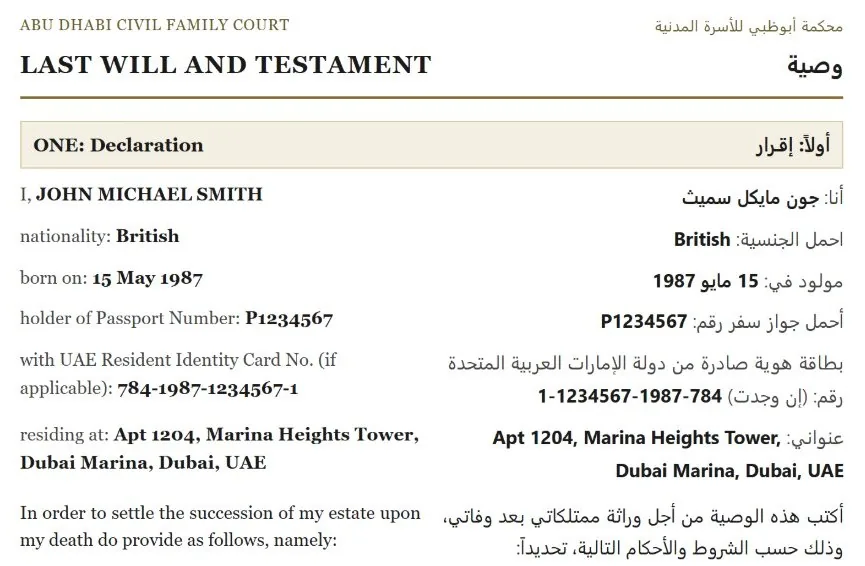
An ADJD Will is a civil Will registered with ADJD's Civil Wills Office under Abu Dhabi Law No. 14 of 2021, on ADJD's bilingual Arabic and English template. It is open to any non-UAE citizen regardless of religion, which makes it the only civil Will route open to Muslim expats.
ADJD Will registration: types, fees and stepsWhat Is a DIFC Will?
A DIFC Will is a non-Muslim Will registered with the DIFC Wills Service Centre under Dubai Law No. 15 of 2017. Its English common law framework gives it freedom of testation: you choose who inherits, without fixed shares.
DIFC Will registration: types, fees and stepsWhat Is an ADGM Will?
ADGM Courts runs a Notary Public and Wills Office that notarises non-Muslim Wills in partnership with ADJD. The service is fully digital and covers three Will types: estate only, guardianship of minor children only, or both together. The Will must be bilingual in Arabic and English and certified by a translator licensed by the UAE Ministry of Justice.
ADGM notarises, but it does not grant probate. Its own guidance directs later UAE probate applications to ADJD's Wills and Probate Office. Eligibility is narrower than ADJD's: non-Muslim, at least 21, and holding assets to dispose of. ADGM pauses new submissions from time to time, so check its notice page first.
What Is a Dubai Courts Will?
The Dubai Courts Notary Public notarises Wills as a notarial service rather than a probate registry. Non-Muslims use it to attest a Will they have drafted, and Muslims can notarise a Sharia-compliant Will there. Documents are handled in Arabic, or translated into it.
How Do the Four Routes Compare?
| Factor | ADJD | DIFC | ADGM | Dubai Courts |
|---|---|---|---|---|
| Authority | ADJD's Civil Wills Office | DIFC Wills Service Centre | ADGM Courts Notary Public and Wills Office | Dubai Courts Notary Public |
| Framework | Abu Dhabi Law No. 14 of 2021, civil law | Dubai Law No. 15 of 2017, common law | Notarial service delivered with ADJD | Notarial attestation under Dubai Courts |
| Eligibility | Not a UAE citizen; 21+; any religion | Never Muslim, 18+, UAE assets or minor children here | Non-Muslim, 21+, holds assets; non-residents need a visit visa or entry stamp | Non-Muslims; Muslims for a Sharia-compliant Will |
| Registration | Online, video notarisation, bilingual | Online, virtual signing, two witnesses, English | Fully digital, virtual notary appointment | Arabic or translated documents |
| Will options | One civil Will format; a couple registers two | Full, guardianship, property, business, financial, digital assets | Estate, guardianship, or both | Attestation of the Will you present |
| Guardianship | Supported within the Will | Guardianship Will, or a drafted Full Will; minor children in Dubai or Ras Al Khaimah | Supported, including guardianship-only | As drafted in the Will |
| After death | ADJD Wills and Probate Office | DIFC Courts jurisdiction | No probate service; goes to ADJD | Depends on the court and the assets |
| Authority fee | AED 950 | AED 5,000 to AED 15,000 | AED 950 to ADJD plus USD 155 to ADGM (about AED 1,520) | Published by Dubai Courts, plus AED 20 |
Scroll the table sideways to see every column.
ADJD or DIFC: which fits you
- Choose ADJD if
- You want the lowest registration fee (AED 950)
- You are Muslim, or were once Muslim
- Your children live outside Dubai and Ras Al Khaimah
- Choose DIFC if
- You have never been Muslim and want freedom of testation
- You want to include assets abroad in a Full Will
- You are 18 to 20, or want to sign from outside the UAE
Our interest: Online Wills Advisor prepares ADJD and DIFC Wills for a fee, and does not offer ADGM or Dubai Courts notarisation. These cards use each authority's published rules and fees, not OWA's prices.
What Types of Wills Are Available in the UAE?
In short
UAE Wills differ by who they cover and what they cover. A Single Will covers one person and Mirror Wills cover a couple, at both ADJD and DIFC. ADJD uses one civil Will format for everything, while DIFC offers six types, each limited to an asset class or to guardianship.
- BothSingle WillOne person, covering their own assets and guardianship wishes
- BothMirror WillsMatching Wills for a couple, registered as two documents; DIFC requires a married couple
- ADJDCivil WillOne bilingual template covering UAE assets, executors and guardians
- DIFCFull WillAll UAE assets, and assets abroad if listed
- DIFCProperty WillUAE property only, up to DIFC's limit
- DIFCBusiness Owners WillUAE shareholdings only, up to DIFC's limit
- DIFCFinancial Assets WillUAE bank and brokerage accounts only, up to DIFC's limit
- DIFCGuardianship WillGuardian appointment only
- DIFCDigital Assets WillSupported cryptocurrencies, assigned through DIFC Courts' non-custodial wallet
What Are Mirror Wills?
Mirror Wills are two near-identical Wills, usually leaving everything to each other and then to the children. Each person registers a separate document.
| ADJD | DIFC | |
|---|---|---|
| Who qualifies | No separate Mirror category | A married couple registering together |
| How it works | Two civil Wills on ADJD's template | Two separate Wills signed in one appointment |
| Full-coverage fee | AED 1,900 (2 × AED 950) | AED 15,000, against AED 20,000 for two Single Full Wills |
Which Type of Will Is Best?
The best type is the narrowest one that covers everything you own and everyone you need to name.
- Mixed UAE assets, or children who need guardians?A full-coverage Will: an ADJD civil Will or a DIFC Full Will.
- All your UAE assets in one class, within DIFC's cap?A DIFC Property, Business Owners or Financial Assets Will, which costs less than a Full Will.
- Only need guardians, with children in Dubai or Ras Al Khaimah?A DIFC Guardianship Will.
How Much Does a Will Cost in the UAE?
In short
Registering a UAE Will costs AED 950 per Will at ADJD and AED 5,000 to AED 15,000 at DIFC, depending on the Will type and whether it is a Single or Mirror Will. Preparation fees come on top, so check whether a quoted price includes the authority fee.
UAE Will authority fees for one person, in AED
| Will type | ADJD single | ADJD mirror | DIFC single | DIFC mirror |
|---|---|---|---|---|
| Full Will | AED 950 (regular registration) | AED 1,900 (2 × AED 950) | AED 10,000 | AED 15,000 |
| Guardianship Will | Covered by the civil Will | Covered by the civil Wills | AED 5,000 | AED 7,500 |
| Property Will | Covered by the civil Will | Covered by the civil Wills | AED 7,500 | AED 10,000 |
| Business Owners Will | Not applicable | Not applicable | AED 5,000 | AED 7,500 |
| Financial Assets Will | Not applicable | Not applicable | AED 5,000 | AED 7,500 |
| Digital Assets Will | Not applicable | Not applicable | AED 5,000 | AED 7,500 |
Scroll the table sideways to see all fee columns.
DIFC figures match DIFC Courts' published schedule, checked 17 November 2026. ADJD charges per Will and publishes no separate Mirror fee. Verify fees with the authority before you budget.
What Other Costs Should You Budget For?
- TranslationCertified translation for any document not in English or Arabic. Ask the translator for a quote before you book.
- Changing a DIFC WillAED 550 per Will. DIFC accepts no codicils, so you sign a complete new Will.
- Changing an ADJD WillNo amendment fee. You register a new Will at AED 950.
What Is the Cheapest Way to Make a Will in the UAE?
Self-drafting on an authority template and paying ADJD's AED 950 fee is the cheapest lawful route. No authority registers a Will for free, and UAE banks and land departments may not act on an unregistered document.
What Can a UAE Will Cover?
In short
A UAE Will can cover UAE property, bank and investment accounts and business shares, and it names your executor. A DIFC Full Will can also include assets abroad, though courts in other countries may not recognise it.
- UAE propertyApartments, villas, land and commercial units in any emirate.
- Bank accounts and investmentsCurrent and savings accounts, fixed deposits, investment accounts and securities at UAE institutions.
- Business sharesStakes in UAE companies, LLCs and free zone entities, subject to any shareholder agreement.
Usually outside the Will: life insurance and pension schemes, which normally pay the named nominee. Check the nominee on each policy.
Who Can Be Your Executor?
A family member or close friend can be your executor, with a substitute in case the first cannot act. DIFC does not require executors or guardians to live in the UAE, but a UAE-based substitute can act faster when the authority needs someone in person.
Can a UAE Will Cover Assets Outside the UAE?
Yes, with limits. A DIFC Will can expressly include worldwide assets, and ADJD confirms that funds and property outside the UAE can also be bequeathed. Recognition abroad is not guaranteed: foreign assets stay subject to the law where they sit, probate for them happens in that country, and several countries apply forced heirship rules that override a foreign Will.
If you hold a Will in another country, have both reviewed together. A new Will with a general revocation clause can cancel an earlier one you meant to keep.
How Does Guardianship Work in a UAE Will?
In short
A UAE Will lets you nominate a guardian for your minor children if both parents die. The court makes the final decision in the child's best interests, and DIFC's guardianship clauses cover only children living in Dubai or Ras Al Khaimah.
- You nominateA guardian and a backup, named in your Will
- The court reviewsYour nomination is evidence of your wishes
- The court decidesIn the child's best interests
Does a Will Guarantee Who Becomes Guardian?
No. The competent court decides guardianship in the child's best interests and treats your nomination as evidence of your wishes. Without one, the court chooses with nothing from you on record, and your home country's embassy may become involved.
Until What Age Does Guardianship Last?
Until the child turns 18. The new Civil Transactions Law (Federal Decree-Law No. 25 of 2025) lowered the UAE's age of majority from 21 to 18 from 1 June 2026. Older Wills that appoint guardians "until the child reaches 21" are worth reviewing against the current law.
Which Children Does a DIFC Guardianship Will Cover?
DIFC guardianship provisions apply only to minor children residing in Dubai or Ras Al Khaimah at the time of probate. DIFC's eligibility test is wider: you can register a DIFC Will if your minor children live with you anywhere in the UAE. ADJD's route is not restricted in the same way, and ADGM offers a guardianship-only Will for eligible non-Muslims. DIFC's online template Full Will cannot appoint guardians, so DIFC parents need a Guardianship Will or a drafted Full Will.
- Dubai
- Ras Al Khaimah
- Abu Dhabi
- Sharjah
- Ajman
- Umm Al Quwain
- Fujairah
Highlighted: DIFC guardianship applies to children living hereOthers: not covered by DIFC; ADJD's route applies
How Do You Make a Will in the UAE?
In short
You make a UAE Will in five steps: check eligibility, gather documents, choose beneficiaries, draft the Will and register it with the authority. No lawyer is required, and no authority publishes a fixed timeline.
- Check eligibilityConfirm you qualify and choose ADJD or DIFC.
- Gather documentsIdentification, family and asset documents.
- Choose beneficiariesDecide who inherits what; name your executor and guardian.
- Draft the WillCheck the Will against the authority's requirements.
- Register the WillSubmit on the authority's portal, pay the fee and verify your identity.
Timing depends on complete documents and the next appointment slot.
The four most common causes of delay
- Untranslated certificate
- Conflicted witness
- Over-limit asset list
- Nominee who has not consented
For full registration steps, see ADJD Will registration and DIFC Will registration.
Do You Need a Lawyer, or Can You Use a Template?
No lawyer is required. Your drafting options are:
- ADJDAuthority templateADJD issues a bilingual civil Will template.
- DIFCSelf-draft, template or DraftsmanDraft your own, use a DIFC template, or appoint a registered Wills Draftsman.
- AvoidGeneric templateMay not match the wording the authority expects.
What Documents Do You Need for a UAE Will?
In short
You need identity documents, details of each beneficiary, executor and guardian, and proof of each asset. Documents not in English or Arabic usually need certified translation. Requirements differ slightly between ADJD and DIFC, so check the authority's current checklist.
- Identity
- Passport copy
- Emirates ID, if resident
- UAE visa page, if you have one
- Proof of address
- Marriage or divorce certificate
- Children's birth certificates
- People
- Full legal name and date of birth
- Nationality and relationship to you
- Contact details
- Written consent from executors and guardians
- DIFC only: a signed Guardianship Statement from each guardian
- Assets
- Title deeds
- Bank and investment statements
- Share certificates
- Vehicle registrations
- A digital asset inventory, without passwords
- Translation
- Certified translation for documents not in English or Arabic
- Attestation and legalisation for documents issued abroad
Count assets accurately. DIFC's limited Will types carry asset caps, and an undercounted list forces a change of Will type.
What Happens After a UAE Will Is Registered?
In short
A registered Will takes effect on death, not before. The executor notifies the authority, which confirms the Will and issues a probate order at DIFC or an executive wording stamp at ADJD. The executor then settles debts and distributes the assets.
- Notify the authorityThe executor notifies the authority and submits the death certificate.
- Will confirmedThe authority finds the Will by its registry number and confirms validity.
- Probate or execution orderA probate order at DIFC, or an executive wording stamp at ADJD.
- Assets distributedThe executor settles debts, then passes assets to the beneficiaries.
When Do Probate or Court Processes Apply?
Probate, the court process that confirms a Will and authorises transfers, or an equivalent step usually applies when an asset leaves the deceased's name: real estate, large bank balances and shares. A registered Will does not remove this step, but it routes it through a known authority.
- DIFCCommon law probateEnglish common law principles. USD 1,500 for a Grant of Probate, paid from the estate. Orders are executed at the Dubai Courts as a standard formality.
- ADJDCivil family lawAbu Dhabi civil family law, through ADJD's Wills and Probate Office, ending in an executive wording stamp.
What Happens to Your Bank Accounts?
In short
A UAE bank may block a deceased customer's account once it has evidence of death, Will or no Will. It releases funds to the executor only after the authority's execution step: a probate order at DIFC or an executive wording stamp at ADJD.
- Bank notifiedEvidence of death reaches the bank
- Account blockedAs the Central Bank's standards permit
- Authority actsProbate order (DIFC) or executive wording stamp (ADJD)
- Funds releasedTo the executor, for distribution
Does a Bank Freeze Your Account When You Die?
It can. Once it has evidence of death, a bank may block an account, an account privilege or a set amount, as the Central Bank's Consumer Protection Standards permit. It then waits for documents showing who has authority over the estate. A registered Will does not prevent this, but it shortens what follows because your executor and beneficiaries are already named.
What Happens to a Joint Account?
Usually not in full. UAE law treats the deceased holder's share separately from the survivor's. The outcome depends on the account mandate, the bank's terms, any debts and any court order. In practice a bank may pause the whole account while it verifies documents and separates the shares.
Can an Executor Withdraw Money From the Deceased's Account?
Not straight away. The bank waits for a document showing who has authority over the estate, which comes from the authority's execution step. Until the bank accepts it, the executor cannot draw on the account.
Plan for a period when your family cannot reach UAE accounts, and check they could meet immediate costs without them.
Sources
The DIFC Wills Service Centre and ADJD publish current fees and eligibility rules, and ADGM Courts and Dubai Courts publish their own. DIFC Courts hear DIFC probate matters, and the Ministry of Justice publishes federal legislation.
- DIFC Courts: Wills FAQ
- DIFC Courts: Fees
- ADGM Courts: Notary Public and Wills
- ADGM Courts: Wills Office FAQs
- ADJD: Abu Dhabi Civil Family Court (civil Wills eligibility)
- ADJD: e-services directory
- DIFC Courts: Digital Assets Will
Official pages checked .
Legislation referenced: Federal Decree-Law No. 41 of 2022; Federal Decree-Law No. 41 of 2024 (replacing the 2005 law); Federal Decree-Law No. 25 of 2025 (Civil Transactions Law); Abu Dhabi Law No. 14 of 2021; Dubai Law No. 15 of 2017. Fees change. Confirm requirements with the registering authority before acting.